
India is deeply concerned over the spike in the price of oil due to the Russia-Ukraine conflict and it is "breaking our back," External Affairs Minister S Jaishankar has said. Addressing a joint press conference with US Secretary of State Antony Blinken after holding bilateral talks, Jaishankar on Tuesday said there is a very deep concern among developing countries about how their energy needs are addressed. Speaking about the Ukraine war, he said: "We have taken the position privately, publicly, confidentially and consistently that this conflict is not in anybody's interest."

'The biggest near-term risk to Indian equities is the outflow of investments to China as tactical trades by foreign investors.'

Experts feel oil prices will remain volatile with an upward bias.

India's trade account could come under pressure and there could be an inflation push if crude oil prices remain above the $90 per barrel (Brent) for a prolonged period since India imports over 85 per cent of its oil and roughly 50 per cent of its gas. A rebound in economic activity is bound to lead to higher fuel demand. While India is the third-largest importer of crude, it is a net exporter of refined products, which helps to compensate to some degree.

'Consider 40% to 50% in equities, 10% in gold as a hedge, and the remaining 30% to 40% split between multi-asset funds and hybrid funds.'

There is no direct impact of the Russia-Ukraine crisis on India in terms of bilateral trade but a surge in oil prices poses considerable risk to the economy, an analyst report said on Friday. International oil prices which have surged past $100 per barrel "pose risks to external stability and currency movement," a Bank of Baroda Economics Research report said. Russia has launched military operations against Ukraine, stoking fears of significant disruption in the region, including loss of life. The West is ramping up financial sanctions against Russia and support for Ukraine.

'Trump administration wanted a positive tone at this summit, but there was still some anxiety that there could be some awkward moments -- and there were not.'
Global supply is staying in excess of demand.
Arunabha Ghosh on why India will increasingly become an energy great power, but not an energy hegemon.

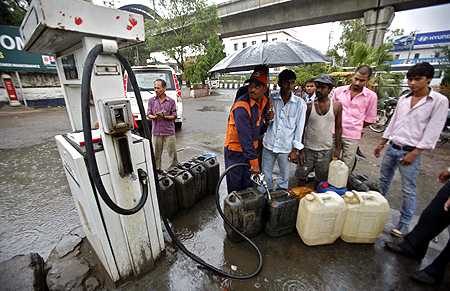
The Central government is stuck between the devil and the deep blue sea as far as the runaway fuel prices are concerned.

India needs to recognise and address challenges posed by its dependence on China for critical minerals and examine the implications of phasing down coal on bank balance sheets as it accelerates its green transition, the government's Economic Survey 2023-24 tabled in Parliament on Monday said. As part of its national plan to contribute to meeting the global goal of limiting the average temperature rise to 1.5 degrees Celsius, India has committed to reducing emissions by 45 per cent below 2005 levels by 2030, achieving 50 per cent cumulative electric installed capacity from non-fossil fuel-based energy resources, and creating a carbon sink of 2.5 to 3 gigatons of CO2 equivalent through additional forest and tree cover.

'2019 was fought on delivery. But in 2024, you can see the before and after effects.'

Carter was in politics, but not a politician, certainly not a transactional politician, points out Shreekant Sambrani.

Inflation is expected to remain low in the near term, in part because of the further declines in energy prices.

In the coming months, globally as well as in India, rice might remain a hot potato.

India's jugalbandhi with coal and clean energy is coming unstuck, neither achieving adequate renewable generation nor ensuring sufficient coal-fired power in the quest to become a $5-trillion economy. Six months have elapsed since Prime Minister Narendra Modi announced an ambitious climate agenda for India at COP26 at Glasgow. The net zero emissions target by 2070 is a distant one, but there are nearer-term plans to meet 50 per cent of energy demand with renewables by 2030 by increasing capacity to 450 Gw. A cursory look at the balance sheet of India's climate progress since November reveals ponderous progress towards meeting the renewables target even as the country is scrambling to expand coal-fired generation in the face of a power crisis.

The world is in a state of crisis and it is difficult to predict how long this state of instability will last, Prime Minister Narendra Modi said on Thursday referring to various global challenges arising out of conflict, war and terrorism among others. In his opening remarks at the Voice of Global South virtual summit, Modi flagged concerns over rising prices of food, fuel and fertilisers, economic impact of the COVID-19 pandemic as well as natural disasters driven by climate change. "We are meeting as a new year dawns and brings new hopes and new energy," Modi said.

Union Finance Minister Nirmala Sitharaman on Tuesday commended Indian financial sector regulators for doing a "world-class job" and bringing greater transparency into the system. Underlining that she is not against questioning or critiquing regulators, Sitharaman said there is a need to be "extremely conscious" about contributions made by them as well. Speaking at the Financial Express Best Banks Awards, the finance minister said, "I strongly recommend that facts are taken on board before we discuss anything to do with the regulators, strictly speaking."

India's e-commerce market alone is projected to reach $200 billion by 2026, making it a prime industry for ambitious entrepreneurs, explains rediffGURU Harsh Bharwani.

India's inflation trajectory in the coming months will be influenced more by the geo-political situation due to the war in Europe and its impact on supply chains and commodity prices. However, the country is better placed than most to "weather the storm" and achieve growth of close to 8 per cent in the current fiscal year, the finance ministry said in its latest monthly economic report on Thursday. "Through the channel of imports, elevated global crude and edible oil prices now have a significant impact on India's inflation outlook. "Government measures to keep the prices of these commodities in check, along with the recent hike in policy rates by the RBI, are expected to temper inflationary pressures in the economy," the monthly economic report for April, drafted by the finance ministry's economic division, said.

India's climate change goals are turning combustible. On the one hand, a protracted dispute between the government and manufacturers over subsidies threatens to slow the pace of electric vehicle (EV) sales. On the other hand, repeated assertions by different arms of the government over banning sales of new fossil fuel-fired vehicles have queered the pitch for energy investments. Before we address the issue of the recommended diesel vehicle ban in the recent report on energy transition, issued months before the next round of global climate talks begin in Dubai in November, let's look at what's at stake.

The government last month announced freeing of auto fuel prices from its control, resulting in a Rs 3.50 per litre hike in petrol prices as domestic rates got linked to global movements.

Global rating agency S&P on Tuesday said even though the US and the Euro zone are headed to recession, India is unlikely to face the impact given the "not so coupled" nature of its economy with the global economy. "Indian economy is a lot decoupled from the global economy than we normally think of, given its large domestic demand, even though you (India) are a net importer of energy. "But you have enough forex reserves on one hand and your companies have managed to maintain healthy balance sheets," Paul F Gruenwald, S&P global chief economist and managing director, told reporters in Mumbai.

Foreign flows into Indian equities are expected to pause in the short to medium term, say analysts. The outlook is influenced by multiple factors, including rising oil prices, actions from global central banks, climbing bond yields, and the dollar index gaining prominence. "Valuations appear rich with the markets at record highs.

The biggest bounce is in the realty sector, where the industry index jumped 80%. There's been a turnaround also in automobiles and ancillaries (up 45%). The pharma and health care indices have a welcome return of roughly 35%.

Tata Steel has a very British problem. The performance of Europe dragged the steel major's October-December (Q3FY23) performance with the UK business accounting for a major part of the operating loss; on the bottom line, the overhang of the British Steel Pension Scheme (BSPS) showed. And a nearly three-year discussion with the UK government on a support package for a green transition resulted in an offer that fell short of the ask.

Usually, a fall in oil prices is followed with a cut in retail prices of auto fuels and the government passes on the benefit to consumers. However, Morgan Stanley believes gains this time around will remain capped.

Pushing a barrel of oil back to around $100 would require a reduction of production of about two million barrels a day - a cut that would fall predominantly on Saudi Arabia.

Oil and LNG prices are likely to shoot up if Iran is to block Strait of Hormuz, through which countries like India import crude oil from Saudi Arabia, Iraq and UAE, leading to a spike in inflation, analysts said on the Iran-Israel conflict. The Iran and Israel conflict has escalated over the last few days. Iran first launched drone and rocket attacks on Israel, which retaliated by firing a missile. Crude oil prices have hovered around USD 90 per barrel since the conflict.

The President said he made the decision in consultation with European allies but added they may not be in a position to join the US in banning Russian energy imports.

At a media briefing, French President Emmanuel Macron said the G20 leaders' declaration "confirms" Russia's isolation for its attack on Ukraine and that the bloc is committed to "just and lasting" peace in the war-torn country.

'For experienced and risk-taking investors, now may be the time to go all in.' 'By 'experienced and risk-taking', I refer to those who remained net buyers in equities during the early stages of the 2020 pandemic.' 'On the other hand, those who exited the markets during the pandemic may go the SIP way.'
The oil industry experienced three upheavals between 1973 and 1991, which seem to be etched in the memory of the industry's decision makers. Naturally, at the sign of a new crisis, the decision makers like to dip into those tumultuous decades to find ways to deal with the new shock, in addition, of course, to expert reports and forecasts. So, the industry bigwigs turned the pages of history to get a peek into the future of oil price movements after Russia invaded Ukraine in 2022, Israel attacked Gaza in 2023, Iran-linked Houthi rebels pounded tankers crossing the Red Sea in support of Palestine the same year, and Iran rained missiles on Israel in 2024.

Trumponomics, poor growth, and high valuation certainly don't make a bullish recipe for Indian markets, warns Debashis Basu.

If international crude oil prices zoom past the current level of about $90 per barrel and move towards $100 and beyond, middle-class consumers are not going to keep quiet about their discomfort, points out Arun Balakrishnan, former chairman and managing director, Hindustan Petroleum.

The finance ministry said on Tuesday that high energy and commodity prices due to the Russian invasion of Ukraine may provide an upside risk to inflation and continued vigil is required. "Going forward, elevated energy and commodity prices may act as an upside risk to the inflation outlook in the near-medium term. "Given the inherently unsustainable nature of high prices, international commodity prices are expected to level off early with an increase in supplies outside the crisis zone," the department of economic affairs said in its latest monthly economic report for February.

After a turnaround in performance by Indian equity markets since July that has seen the S&P BSE Sensex and the Nifty50 wipe out the year-to-date losses, analysts suggest investors start nibbling into stocks that are focused on the domestic economy. While they say intermittent corrections, led by policies of global central banks and other economic data, cannot be ruled out, analysts expect India's relative outperformance among global equity markets to continue as it looks better placed with a healthy economic recovery, and remains one of the fastest growing major economies. In this backdrop, Neeraj Chadawar, head of quantitative equity strategy at Axis Securities, believes that amid global slowdown, aggressive tightening by the central banks, and preference for domestic interests first (by the local government), export-oriented themes are likely to be muted or will deliver conservative returns in the near-term.

Billionaire Mukesh Ambani's Reliance Industries and Tata Group have made it to the prestigious TIME's list of 100 World's Most Influential Companies of 2024. TIME called Reliance 'India's Juggernaut'. This is the second time that Reliance has found its way into the TIME list. Jio Platforms, the firm that holds digital properties of the conglomerate, was included in the inaugural TIME 100 Most Influential Companies List of 2021. Serum Institute is the other Indian company on the list.

'Like every Budget, this time, too, there is chatter around tinkering with the long-term capital gains tax.' 'Investors may not want to jump into the markets until there is clarity on this front.'

India has built up buffers against cyclical difficulties and has ample foreign exchange reserves to withstand pressure on credit worthiness, S&P Global Ratings said on Thursday. Speaking at the India Credit Spotlight 2022 webinar, S&P Sovereign & International Public Finance Ratings director Andrew Wood said the country has a strong external balance sheet and limited external debt, making debt servicing not so expensive. "The country has built up buffers against cyclical difficulties like those, which we are experiencing right now," Wood said.
